Saturday, January 31, 2009

Spotlight On: HEARTLAND

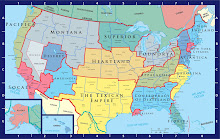
Heartland


AREA
395,000 sq.m. (4th)
POPULATION
21,512,000 (7th)
DENSITY
54 people per square mile. (15th)

CAPITAL
Kansas City, Missouri
STATES
Wabash (Evansville), Illinois (Springfield), Ozark (St. Louis), Iowa (Des Moines), Missouri (Kansas City), East Kansas (Topeka), West Kansas (Colorado Springs), Nebraska (Lincoln), Oglala (North Platte).

RELIGION
Protestant, Baptist
LANGUAGE
English

NATL INCOME
1,230 billion
MEDIAN INCOME
$57,157 (8th)

ECONOMY
Heartland’s economy is generally medium-to-strong, but varies greatly with natural agricultural cycles, being based almost entirely off of agriculture. It maintains informal trading with most countries, serving as the primary source of certain foods for some like Dixieland, Montana, Superior, Deseret and Amerindia. It has enough natural resources to be generally self-sufficient, although these are in decline. Its economy is almost entirely agricultural export-based, although it does have to import important goods such as cotton and timber from other nations, so its prices are heavily regulated. Its cities, including Kansas City, St. Louis and Omaha, do have some financial strength, but not enough to truly drive the economy. The cost of living is generally median-low.

OVERVIEW
Heartland maintains a powerful position in continental politics due to its central positioning and agricultural importance. It has experienced times of dire poverty and high crime, as its fortunes fluctuate yearly with the agricultural yield. Heartland became the site of a bitter war with Texas in the 1980s, when that nation forcibly annexed Arkansas and Oklahoma. Though Arkansas voted to allow the annexation, Oklahoma at first did not, leading to a bloody conflict between Texican guards and the Oklahoma Resistance. At the time, Heartland was in a serious economic slump, and eventually did allow Texas to purchase the land. Heartland gained more land in the Redivision of 1994 (in former Illinois, Indiana, and Colorado) and has since repaired relations with Texico. For the most part, the administrations of Heartland have been populist, conservative-agrarian focused, and control of the region has reverted to its pre-Division Republican Party dominance. Current President John Ashcroft (R-Ozark), serving his second nonconsecutive term, has come under scrutiny for increasingly theocratic remarks that many in ANTU nations worry is an indicator of a future alliance with Dixieland.

HEAD OF STATE


President John Ashcroft,
Republican Party


Vice President J.C. Watts,
Republican Party.

Wednesday, January 28, 2009

Spotlight On: TEXICO

Texico
(The Texican Empire)


AREA
594,000 sq.m. (3rd)
POPULATION
42,792,000 (1st)
DENSITY
72 people per sq.m. (14th)

CAPITAL
Dallas, East Texas
STATES
Louisiana (Shreveport), Arkansaw (Little Rock), Oklahoma (Oklahoma City), East Texas (Fort Worth), Alamo (Austin), Comancheria (Amarillo), West Texas (Lubbock), Tejas (Corpus Christi), New Mexico (Roswell).

RELIGION
Protestant, Catholic, various
LANGUAGE
English, Spanish

NATL INCOME
2,175 billion
MEDIAN INCOME
$50,838 (9th)

ECONOMY
The Texican Empire has probably the strongest economy on the continent. It’s extremely rich in both natural resources and farmland, and its cities like Houston, Dallas and Austin are heavy centers of industry, finance, chemicals, defense, engineering and high-tech growth. As a result, it has the rare ability to be almost completely independent of foreign nations. It does, however, make a significant amount of money from exports to smaller countries, especially in the Caribbean and Central and South America. It generally runs competitively to the ANTU nations and is viewed as an aggressive expansionist, both in terms of business and territory (Texico recently annexed three states from the government of Mexico, almost doubling its size and population). Texico does maintain trade with Dixieland, Appalachia and Mexico, and occasionally, Heartland. The cost of living is median in most areas.

OVERVIEW
Texas was originally the only new nation created by the Division of 1980 made up of a single state (outside of Alaska and Hawaii). This was due both to its size and its extraordinary resources and independence. Three men – Governor John Connally and Senators George Bush and Lloyd Bentsen – were almost single-handedly responsible for the construction of the new nation and its position as a strong international presence right from the beginning. After President Bentsen was assassinated in a Dallas motorcade in 1983 by a Mexican-Marxist radical, President Connally implemented an aggressive foreign policy and economic structure, and by the end of the decade, Texas was firmly established as a plutocracy, with the dominant Lone Star Party being tied heavily into business and the oil industry. In the late 80s, Texas annexed Arkansas from Heartland (wanting access to the Mississippi River), and later invaded Oklahoma, leading to the bloody Oklahoma Border War. Both states would eventually fall to Texas, as would most of Louisiana. In 1996, Democrat Phil Gramm was elected, but soon proved in the eyes of the international community to be merely a figurehead administration designed to allow the Lone Stars a convenient return to power. The administration of Tom Delay almost led Texico (as it had been called since a famous speech by President G. Bush spelling out Texico’s manifest destiny to control Central America) to war with Atlantica and other ANTU nations over the territory of Cancun, which the Mexican government was considering selling. In early 2004, Mexican-Marxist suicide bombers destroyed part of the Alamo in retaliation for what they viewed as Texico’s harmful economic and immigration policies. Texico immediately mobilized its forces and sent tanks rolling across the border into three Mexican states, where they were greeted as liberators by a populace sick of the weakened and corrupt Mexican PRI party. Texico still holds territory in Mexico, despite condemnation by the international community, and the situation has devolved to a legitimate border war between the two nations. There is some question whether new president John Ellis Bush will resolve the situation in peace by withdrawing troops, or escalating the fighting by a full-scale attack on the rest of Mexico.

HEAD OF STATE


President John Ellis Bush,
Lone Star Party


Vice President Karl Rove,
Lone Star Party.

Monday, January 26, 2009

Spotlight On: NEORLEANS

Neorleans


AREA
10,000 sq.m. (20th)
POPULATION
1,717,000 (17th)
DENSITY
172 people per sq.m. (8th)

CAPITAL
New Orleans
STATES
None

RELIGION
Catholic, Vudun, various
LANGUAGE
French-Cajun, English, various

NATL INCOME
40 billion
MEDIAN INCOME
$23,582 (19th)

ECONOMY
The economy of Neorleans is seriously struggling. Neighbor to two aggressive, hostile nations (Dixieland and Texico), Neorleans has so little farmland and industry that its only substantial export is shellfish. It is a member of the American Northeast Trade Union, and is highly reliant on it for necessarily cheap imports. Trade to and from the nation is also problematic; ships traveling north on the Mississippi pass through four other nations before reaching the ANTU bloc; however, Neorleans does control the mouth of the Mississippi and has levied substantial taxes on foreign ships, coming under heavy fire. It is also dependent on the channel between Florida and Cuba. Neorleans does have some strategic oil reserves and is mostly energy independent. It is also popular for its tourist trade in the city of New Orleans. Income is low, and a large portion of the populace is destitute. Cost of living is fairly low.

OVERVIEW
Neorleans was created by charter of the United Nations in 1992, out of land that had belonged to Dixieland. The heavily African-American population was coming into conflict with the administration of white Louisiana Governor David Duke, and the problem was exacerbated when foreign black activists like Jesse Jackson and Al Sharpton promoted the idea that blacks from all over Dixieland move to the city of New Orleans in order to overpower the electorate and elect a black state government. When their gambit worked and Ernest `Dutch’ Morial was elected, a white backlash ensued. Jackson was assassinated by white radicals, and the region fell into rioting. Governor Duke sent the National Guard in, with over a thousand deaths as a result. Dixieland was forced to give up a portion of the delta to the black separatists, while most of the remainder of Louisiana it would cede to Texico in the 1994 Redivision. Today, Neorleans is a struggling, poor nation, utterly dependant on trade with other nations. It has maintained its black majority in populace and elected officials. In 2007, much of the area was devastated by Hurricane Melissa, setting the struggling nation back even further, but ANTU and international aid prevented a total collapse. The nation has recently undergone an increased militarization, under perceived threat of annexation by both Texico and Dixieland.

HEAD OF STATE


Governor Donna Brazile,
Democratic-Equality Party


Lt. Gov. William Jefferson,
Democratic-Equality Party

Thursday, January 22, 2009

Spotlight On: FLORIDA

Florida
(The Florida-Disney National Corporation)


AREA
39,000 sq.m. (17th)
POPULATION
14,601,000 (10th)
DENSITY
374 people per square mile. (2nd)

CAPITAL
Orlando, Kissimmee
STATES
St. Augustine (Jacksonville), Kissimmee (Orlando), Cypress (Fort Myers), Biscayne (Miami), The Keys (Key West), Tampa (Tampa)

RELIGION
Catholic, Jewish, Protestant, Various
LANGUAGE
Spanish, English, Various

NATL INCOME
718 billion (estimated)
MEDIAN INCOME
$49,202 (10th)

ECONOMY
Florida is unique in that it is a nation owned entirely by a corporation: in this case, the Disney Corporation. The nation’s economy is co-dependent with that of Disney since 1990. Generally the economy is strong, maintaining a membership and free trade with the American Northeast Trade Union. Its big cities, including Miami, Tampa and Jacksonville, are centers of light industry and electronics, but the vast majority of the nation’s income depends on international tourism. Unlike most other ANTU nations, it has struck extensive deals with Russia for free trade of natural resources, and in return, Florida has become one of the most popular tourist destinations for middle class Russians. Florida has risen to a place of prominence in Caribbean trade, and has a crucially important trade agreement with Cuba. It is also the largest North American exporter of citrus. Its mostly service economy does make it susceptible to the economies of other nations. The cost of living is middle-to-high.

OVERVIEW
Originally part of Dixieland, the Florida panhandle was sold by President Fob James to the Disney Corporation in 1990. Dixieland had been struggling financially, and was promised favorable trade and other amenities with the new corporate nation. Florida is now governed by an elected Executive Governor, but the Governor’s actions and decisions are largely subject to the whim of the Board of Disney, making the un-elected Executive President of the Disney Corporation the effective leader. Florida is run like a corporation along the governing mandates set by long-term Executive President Michael Eisner (now President Emeritus). Under the leadership of Eisner and numerous Executive Governors, Florida made extensive trade deals with Cuba and Russian Alaska, and joined ANTU, on which it is highly reliant. The popular perception of Florida is a nation with an almost completely content populace; in reality, the government has come under heavy internal criticism from revolutionary, progressive, anti-capitalistic, and independent parties aimed at returning the nation to a non-corporate system of government. In addition, some other nations have cited Florida with quality of life crimes like excessive curfews, draconian laws and the forced deportation of the nation’s criminal and homeless populations.

HEAD OF STATE


Executive President George Mitchell,
Disney Corporation


Executive Governor Mel Martinez,
Democratic Party.

Friday, January 16, 2009

Spotlight On: DIXIELAND

Dixieland
(The Confederate States of Dixieland)


AREA
204,000 sq.m. (6th)
POPULATION
22,960,000 (5th)
DENSITY
113 people per square mile. (13th)

CAPITAL
Montgomery, Alabama
STATES
Georgia (Atlanta), Okefenokee (Macon), West Florida (Tallahassee), Magnolia (Mobile), Alabama (Montgomery), Cumberland (Birmingham), Mississippi (Jackson), Piedmont (Columbia).

RELIGION
Southern Baptist (official), Protestant
LANGUAGE
English

NATL INCOME
747 billion.
MEDIAN INCOME
$32,539 (16th)

ECONOMY
Dixieland’s economy is weak by North American standards. Due to its politics and policies against `secular states’ it maintains no formal trade with any nation except Texas, Heartland, and recently, Deseret. Because of this, certain goods not produced in the region (for example, potatoes, cranberries, maple syrup) are extremely expensive, if available at all. Its cities, including Atlanta, Jackson and Mobile, are centers of light industry, especially in chemicals, food processing and light electronics. With the exception of some recent development in Atlanta, Dixieland suffers a serious lack of hi-tech and finance operations, and a consistent decline of educational standards, leaving the nation competitively outpaced by most of the rest of the continent. Dixieland is mostly dependent on its two richer neighbors for its energy, having lost what slim reserves they did have with the secession of Neorleans. Dixieland has struck extensive deals for sugar and rice with island republics in the Caribbean. A significant amount of the Dixieland populace is destitute, although there is a very small wealthy `plantation class’. The cost of living is generally low.

OVERVIEW
Dixieland is a moderately powerful nation, but is considered a hostile one by much of the rest of the world. In its early history, white Christian conservatives in the Dixiecrat party dominated, leading to nonviolent persecution of both ethnic and religious minorities. This boiled over in the early 1990s, when black separatists, inflamed by foreign activists like Jesse Jackson and Al Sharpton, advocated a mass migration to Louisiana in order to take over the government of one state (similar to the New Hampshire Free State project begun in the 1970s). The Dixieland government cracked down, leading to bloodshed, and eventually the separation of Neorleans. Dixieland profited from the sale of Florida to the Disney Corporation, and in the Redivision of 1994 lost the rest of its land in Louisiana, and some of northern Alabama, but gained land in South Carolina. In 1996, a conflict erupted over an Atlantican plane crash in Okefenokee, but the situation was calmed by governor Sam Nunn, a liberal. When Nunn came to power as President in the next election cycle, international observers expected a progressive revolution in the nation. But within a year and a half Nunn had been violently overthrown by Dixiecratic loyalists led by Newton Leroy Gingrich, who propped up Zell Miller of Mississippi as President. In 2004, an even more fiercely theocratic wing of the Dixiecrats under James Dobson of Louisiana came to power, leading to a massive exodus of progressives and ethnic minorities (including Cynthia McKinney, current Vice President of Pacifica). Dixieland came to further international attention over a rash of hate crimes in 2006. Despite a struggling economy, Dixieland has remained aggressive in its international dealings and, much to the concern of the ANTU and UN member nations, has struck numerous trade deals with Texico. There is further concern among international observers that Dixieland will try to retake Neorleans in the near future.

HEAD OF STATE


President James Dobson,
Christian-Dixiecrat Party


Vice President Ralph Reed,
Christian-Dixiecrat Party

Thursday, January 15, 2009

Spotlight On: FOUNDRYA

Foundrya
(The Republic of Foundrya-Lakeland)


AREA
173,000 sq.m. (7th)
POPULATION
42,380,000 (2nd)
DENSITY
245 people per square mile. (4th)

CAPITAL
Toledo, Erie
STATES
Niagara (Buffalo), Pittsylvania (Pittsburgh), Erie (Cleveland), Ohio (Columbus), Michigan (Lansing), Huron (Muskegon), Indiana (Indianapolis), Chicago (Chicago)

RELIGION
Catholic, Jewish, Protestant, Islamic, various
LANGUAGE
English, various

NATL INCOME
2,606 billion
MEDIAN INCOME
$61,496 (5th)

ECONOMY
Foundrya’s economy is one of the strongest on the continent. It is a member nation of the American Northeast Trade Union and freely trades resources with its other member nations. Its big cities, including Chicago, Detroit and Cleveland, are centers of heavy industry and powerful finance capitals. Foundrya has enough natural resources to supply its own energy and export some to other ANTU nations. It also is a major exporter of cattle, corn, soy, automobiles, electronics, and iron. It is a prominent international force, although downturns in the automobile industry and heavy pollution have hampered its recent economic growth; however, other continental nations have put restrictions on importing automobiles from overseas, which is expected to help. The cost of living is middle-to-high.

OVERVIEW
Originally known as Lakeland, Foundrya was from its inception a powerful continental presence, containing within its borders much of the former U.S.’s industrial base and major cities. It is a founding member of the American Northeast Trade Union, and is the chief supplier and processor of petroleum and natural gas (along with Canada) for those nations. Despite its wealth and size, Foundrya has gone through difficult economic times, including a serious depression in the early 1990s that resulted in race riots, excessive crime, and the burning of the city of Detroit. Its leadership has fluctuated from internationalist Republicans like Gerald Ford and Lynn Morley Martin, to business-oriented, non-interventionist Independents like Gus Grissom and Jack Murtha, to liberal Democrats like Paul M. Simon. Corruption has run rampant in Foundryan leadership, implicating numerous governors, senators, 3rd Vice President Don Riegle, and 5th President Morry Taylor, who was impeached due to allegations of improper financial operations. Foundrya has maintained itself as an important international power, for the most part allying itself with the other ANTU nations. In recent times, an impending recession and reduced demand for automobiles has again threatened Foundrya’s economy. Newly elected president Jesse Jackson Jr., an Illinois Democrat and son of the iconic assassinated activist, made history as the first popularly elected black president outside of Neorleans.

HEAD OF STATE


President Jesse Jackson, Jr.,
Democratic Party


Vice President Jennifer Granholm,
Democratic Party

Wednesday, January 14, 2009

Spotlight On: APPALACHIA

Appalachia


AREA
150,000 sq.m. (10th)
POPULATION
18,392,000 (9th)
DENSITY
122 people per square mile. (11th)

CAPITAL
Nashville, Tennessee
STATES Tennessee (Memphis), Franklin (Knoxville), Kentucky (Louisville), Vandalia (Lexington), West Virginia (Roanoke), Westsylvania (State College).

RELIGION
Protestant, Baptist, various
LANGUAGE
English

NATL INCOME
568 billion
MEDIAN INCOME
$30,874 (17th)

ECONOMY
Appalachia’s economy is fairly weak. Landlocked except for access to the Mississippi river, with extensive mountain ranges on two of its sides, and resisting formal membership to the American Northeast Trade Union, Appalachia is at a disadvantage. Its cities have moderate light industry, but a substantial lack of hi-tech, chemical and finance growth. Its chief agricultural products are cotton, poultry, timber and especially tobacco; in recent times, however, other countries have put in place substantial smoking bans, seriously damaging the Appalachian income. Appalachia is somewhat energy self-sufficient on coal and mining, although it has struck informal deals with Foundrya, and more recently Texico, to import oil. Parts of the mountains and the Nashville area have developed a decent tourist trade. In recent years it has taken to heavily taxing its stretches of the Ohio and Mississippi rivers in order to bolster its economy, to the discomfort of the ANTU nations. The median income is low, but so is the cost of living.

OVERVIEW
Appalachia is one of the weaker nations on the continent, both in terms of economic growth and international relevance. Difficult terrain negatively impacts trade, and a slightly isolationist and traditionalist mindset, as well as four divisive but often indistinct political parties, have led to frustration and an exodus of progressive and scientifically minded citizens to other nations. Appalachia’s trade agreements are largely informal, and its alliances weak in recent years, although it started off as a member of what would eventually become ANTU. In the Redivision of 1994, Appalachia lost most of its land in North and South Carolina, but gained a substantial portion of Virginia, the middle third of Pennsylvania, and some land in Alabama. Its administrations have been characterized mostly by populist politics, with social conservatism often (but not always) defeating economic issues at the polls. President Albert Gore Jr. (Independent, Tennessee) had attempted to transform the country’s energy policy towards total independence, but conservatives opposed to the slightly higher taxes made that an impossibility. The economy hit rock bottom in the administration of Lamar Alexander (Republican, Franklin). Newly elected President Fred Thompson (Independent-Republican, Tennessee) won on a platform of stronger economic policy, including taxing the Mississippi river. There is some concern in ANTU nations that Thompson would be open to an alliance with Texico.

HEAD OF STATE


President Fred Dalton Thompson,
Independent-Republican Party


Vice President Karen Kwiatkowski,
Independent-Republican Party